
-November soybean crush slightly lower than expected
-November soybean oil stocks higher than expected-2019/20 first quarter corn for ethanol usage down 5.1%, but November up from last year
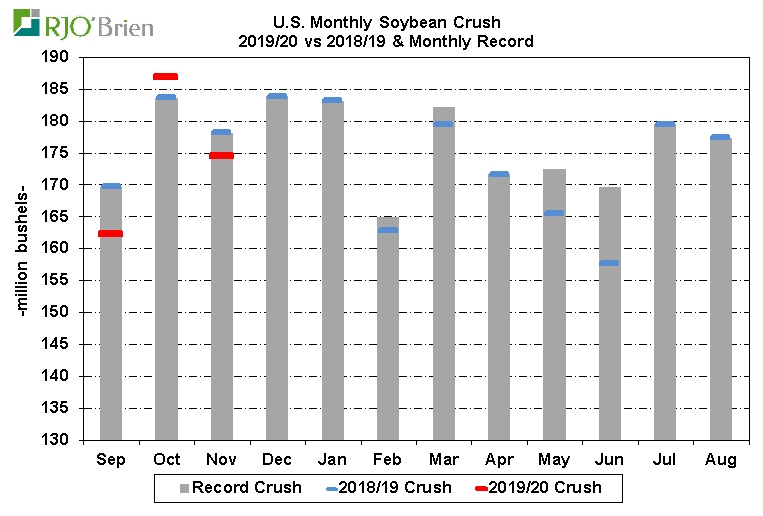
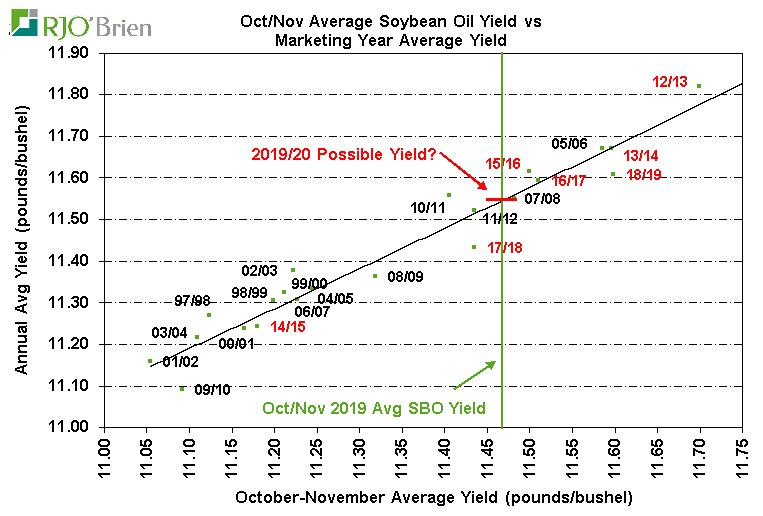
USDA reported November U.S. soybean crush was 174.6 million bushels, below average market expectations of 175.9 million bushels (175.0-177.0 million range of ideas) and down from 187.0 million in October and 1.9% below last year’s record November crush of 178.1 million bushels. For the first quarter of 2019/20, crush of 524.0 million bushels was down 1.3% from last year’s 530.9 million, leaving Dec-Aug crush needing to total 1.581 billion bushels in order for the USDA’s annual estimate of 2.105 billion bushels to prove correct in what would be a 1.3% increase from last year’s 1.561 billion bushels for the 9-month period. November U.S.-wide crush was 5.9% larger than NOPA-member crush for the month, less than the 6.4% and 6.6% differences in September and October. U.S. soybean oil production in November was 2.000 billion pounds, down from 2.148 billion in October and 2.061 billion last year November, with the U.S. average soybean oil yield ticking down to 11.45 pounds/bushel in November from 11.49 in October and last year’s 11.57 in November. The October-November average yield of 11.47 pounds/bushel compared to last year’s 11.60, which eventually saw the 2018/19 marketing year average soybean oil yield come in at 11.61 pounds/bushels. As seen in the 2nd chart below, the relationship between the Oct-Nov average soybean oil yield and the marketing year average yield is a rather strong one, with the 11.47 Oct-Nov average this year implying a marketing year average yield likely in the 11.50-11.55 range given the situation in recent years in particular. USDA is currently assuming the 2019/20 soybean oil yield essentially unchanged from last year at 11.60 pounds/bushel. USDA reported end November U.S. soybean oil stocks were 1.880 billion pounds, up from 1.821 billion in October and well above average market expectations of 1.839 billion pounds and the range of ideas of 1.802-1.870 billion, while being only marginally below last year’s November stocks of 1.900 billion pounds. Based on estimated exports in November, domestic soybean oil usage was implied down roughly 13% from last year after October domestic usage was down 4.3% from last year. U.S. soybean meal production in November of 4.112 million tons was down from 4.377 million in October and essentially unchanged from 4.155 million last year. November soybean meal demand was implied down roughly 3-4% from last year vs unchanged in October.
USDA reported 456.7 million bushels of corn was used for ethanol production in November, up from 433.1 million in October (revised down from 436.8 million initially reported) and 2.1 million bushels above last year’s 454.5 million bushels, the first year-over-year increase in corn for ethanol usage since September 2018. USDA reported 7.2 million bushels of sorghum was used for ethanol production in November, unchanged from October and a bit below last year’s 9.5 million, resulting in corn accounting for 98.4% of feedstocks used for ethanol for the month. For the first quarter of 2019/20, total corn for ethanol usage of 1.295 billion bushels was down 5.1% (70.3 million bushels) from last year’s 1.366 billion. Based on preliminary ethanol production estimates for the month, the average ethanol/corn yield in November of around 2.86 gallons/bushel was down from 2.95 in October and 2.96 in September, which is something that will need to be watched as more new crop supplies make their way into ethanol plants as a lower ethanol yield would imply a greater number of bushels of corn will be needed for each gallon of ethanol demand relatively speaking. We currently estimate ethanol production will need to run roughly 1.6% above year ago levels through the end of the marketing year in order for the USDA’s 5.375 billion bushel annual corn for ethanol usage estimate to be reached. While ethanol production has averaged 2.3% below last year so far in 2019/20, the last three weeks have averaged +2.7% year-over-year.