- Global stocks plunge as Washington uncertainty grows
- U.S. government shutdown may last into January
- U.S. home prices are softening
- 5-year T-note at a 7-month low ahead of today’s auction
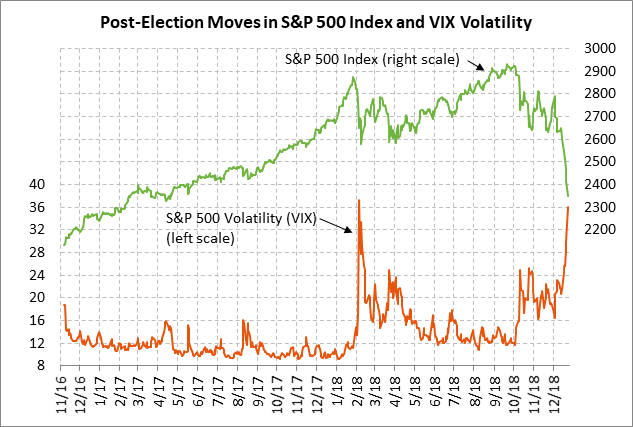
Global stocks plunge as Washington uncertainty grows — The S&P 500 index on Monday plunged by -2.71% to a new 1-3/4 year low after last Friday’s report by Bloomberg that President Trump has repeatedly told aides in recent days that he would like to fire Fed Chair Powell. The Fed last week went ahead with its well-telegraphed interest rate hike despite Mr. Trump’s repeated warnings in tweets against more interest rate hikes.
Treasury Secretary Mnuchin this past Saturday tried to beat back the Powell report by quoting Mr. Trump as saying, “I never suggested firing Chairman Jay Powell, nor do I believe I have the right to do so.” However, Mr. Trump on Monday then released another fusillade against the Fed’s interest rate hikes, although he at least did not specifically mention Fed Chair Powell. On Tuesday, Mr. Trump in a session with reporters in the Oval Office said that he opposes interest rate hikes but suggested he has basic confidence in the Fed.
The markets were also concerned on Monday after news that Treasury Secretary Mnuchin on Sunday did a welfare check by talking with the CEOs of the largest six U.S. banks. Mr. Mnuchin received assurances that liquidity is adequate and the banks are stable. However, Mr. Mnuchin’s bank-check made the markets wonder whether Mr. Mnuchin might know something about banking system weaknesses that the markets don’t yet know.
Mr. Mnuchin on Monday then held a conference call with the President’s Working Group on financial markets with representatives from the Fed, SEC, CFTC, FDIC and other agencies. Mr. Mnuchin was assured by regulators that the markets are operating normally.
Mr. Trump on Tuesday said he has confidence in Treasury Secretary Mnuchin despite questions on Wall Street about whether Mr. Mnuchin made matters worse by calling big-bank CEOs on Sunday and holding what amounted to an emergency conference call on Monday with regulators. In a response to a question from reporters about whether he has confidence in Mr. Mnuchin, Mr. Trump said, “Yes I do, very talented guy, very smart person.”
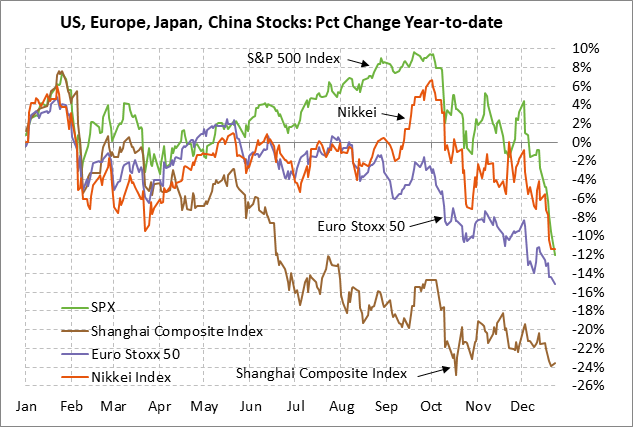
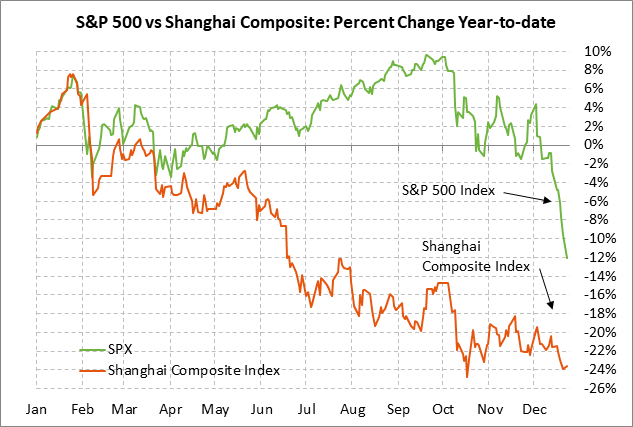
Monday’s plunge in the S&P 500 index to a new 1-3/4 year low sparked some big losses in Asian stocks on Tuesday. After being closed for a holiday on Monday, Japan’s Nikkei index on Tuesday went into near free-fall and closed the day -5.01% lower at a new 1-3/4 year low. The Nikkei index on Tuesday fell into bear territory with an overall -21.8% sell-off from October’s 27-year high. The Shanghai Composite index on Tuesday fell to a new 2-1/4 month low but was then able to recover and close the day only -0.88% lower on reports that the state-connected funds were buying large-cap stocks. The Euro Stoxx 50 index on Monday fell by -0.89% but managed to stay above last Friday’s 2-year low, where the index fell by -20.3% from November’s 3-1/2 year high.
U.S. government shutdown may last into January — About one-quarter of the U.S. government has been shut down since last Friday night when the continuing resolution expired. Congress went home for the Christmas holidays and the Senate is not due to reconvene until Thursday. Thursday is the first day that a vote could be held to reopen the government.
However, Senate Majority Leader McConnell said he will not hold any votes until there is a 3-way deal that has been agreed to by the White House, Congress, and Senate. The key negotiations are between the White House and Senate minority leader Schumer since some Democratic votes are necessary to get a spending bill passed in the Senate.
White House Budget Director Mulvaney on Sunday said that the Trump administration and Senate Democrats are far apart in their negotiations and that the shutdown could last into January. Democrats will take over the House on January 3 when the new term begins. Democrats are refusing to provide the $5 billion in wall funding that President Trump is demanding and Mr. Trump apparently does not want to give any concessions that the Democrats might take in return for $5 billion in wall funding such as a DACA fix or other immigration concessions.
The U.S. stock market has reacted negatively to the government shutdown mainly because it represents a preview of the political strife that will prevail next year once Democrats take over the House on January 3. Even worse for the markets, Congress and the White House will need to pass a debt ceiling hike by next summer to avoid a Treasury default. The debt ceiling suspension expires on March 1 and the Bipartisan Policy Center estimates that the Treasury could hit its X-date as soon as mid-summer.
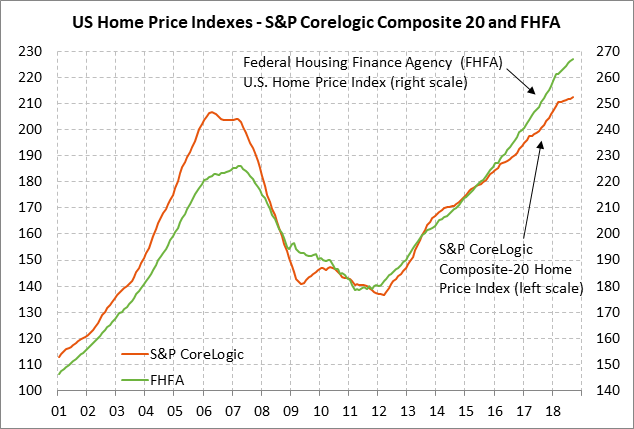
U.S. home prices are softening — The consensus is for today’s Oct S&P CoreLogic composite-20 home price index to show an increase of +0.3% m/m and +4.8% y/y following Sep’s report of +0.3% m/m and +5.2% y/y. The Composite 20 index has seen a weakening trend since April due to poor home sales and resistance to high home prices. September’s +5.2% y/y advance was the weakness year-on-year increase in nearly two years.
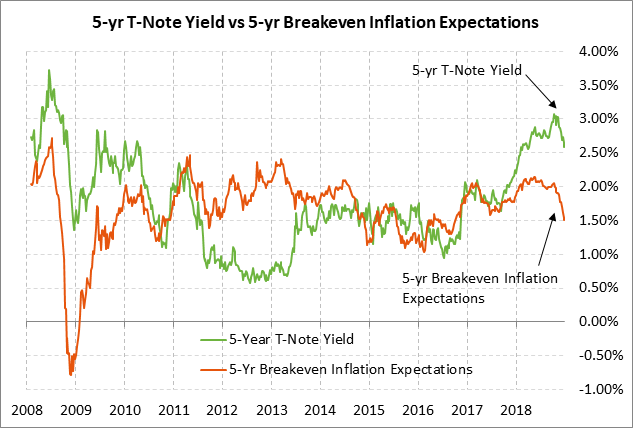
5-year T-note at a 7-month low ahead of today’s auction — The Treasury today will sell $18 billion of 2-year floating-rate notes and $41 billion of 5-year T-notes. The Treasury will sell $32 billion of 7-year T-notes on Thursday, concluding this week’s $131 billion T-note package. The benchmark 5-year T-note on Monday fell to a new 7-month low of 2.58%. The 12-auction averages for the 5-year are as follows: 2.47 bid cover ratio, $50 million in non-competitive bids, 4.0 bp tail to the median yield, 19.5 bp tail to the low yield, and 53% taken at the high yield. Indirect bidders have taken an average of 61.1% of the last twelve 5-year T-note auctions, moderately below the coupon median of 63.0%.