- Odds improve for some stimulus measures as new proposals emergeÂ
- Fed Beige BookÂ
- Nov U.S. ADP report expected to show a continued recovery in U.S. labor market
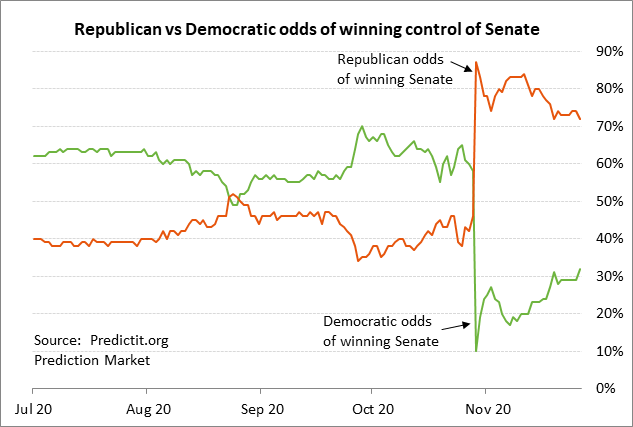
Odds improve for some stimulus measures as new proposals emerge — The odds improved on Tuesday for a lame-duck stimulus bill after Democratic and Republican leaders issued new proposals. Also, Senate Majority Leader McConnell said that a stimulus bill could be added to the must-pass spending bill that must be approved by December 11 to avoid a U.S. government shutdown, which would make it easier to get stimulus measures passed.
The details of yesterday’s new stimulus proposals were not made public, meaning it remains unclear whether Republicans and Democrats are any closer to a deal. However, there is pressure to get a deal done within the next several weeks because there is a fiscal cliff at year-end when some key stimulus measures expire, such as pandemic-related unemployment benefits.
Speaker Pelosi on Tuesday delivered a new proposal to Treasury Secretary Mnuchin, although the details were not immediately available. Pelosi-Mnuchin were discussing a deal of around $1.8 trillion when talks broke down ahead of the election.
Meanwhile, Mr. McConnell sent a new stimulus proposal to Republican Senators to gauge their reaction. There was no word on the size of the package, although it appears likely that it is roughly the same deal Mr. McConnell has been pushing for weeks of about $500 billion. Senator Roy Blunt (R-Mo), a member of the Republican leadership, said he expects the new bill to be essentially the same as the old bill, according to reporting by The Hill.
Also, White House press secretary Kayleigh NcEnany said the White House was in talks with Republican Congressional leaders about a “targeted” aid package, which has recently been the code word for a limited-size package.
The good news is that Republicans may be willing to go bigger on a stimulus bill now that the Treasury has some $455 billion of cash that it clawed back from unused relief funds. Using that money for other pandemic aid purposes would not add to the national debt, making it more palatable as a funding source for debt-averse members of Congress.
Meanwhile, a bipartisan group of Senators on Tuesday released a $908 billion stimulus proposal, which incorporated the Treasury’s unused aid money to reduce the bottom-line cost of the plan. That proposal did not receive any indications of approval by Democratic or Republican leadership, but it nevertheless showed that there is a desire among many Congressional members to provide some additional bipartisan aid by year-end.
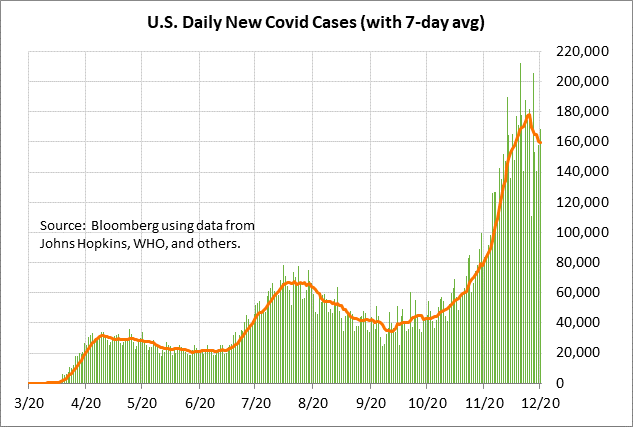
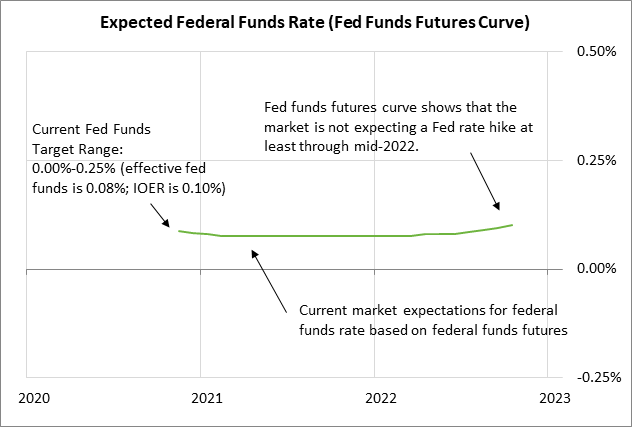
Fed Beige Book — The Fed today will release its Beige Book survey of the U.S. economy ahead of the next FOMC meeting on Dec 15-16. The markets are worried that the U.S. economy is losing momentum due to the recent surge in the pandemic and the expiration of previous stimulus measures.
There continues to be talk about the possibility of a double-dip recession if the pandemic surge worsens and if Congress cannot pass additional stimulus. The pandemic surge may get worse in the wake of holiday gatherings for Thanksgiving and Christmas. The pandemic surge may not end until spring 2021 when a seasonal surge has peaked and until vaccinations become widespread enough to bring down the infection rates.
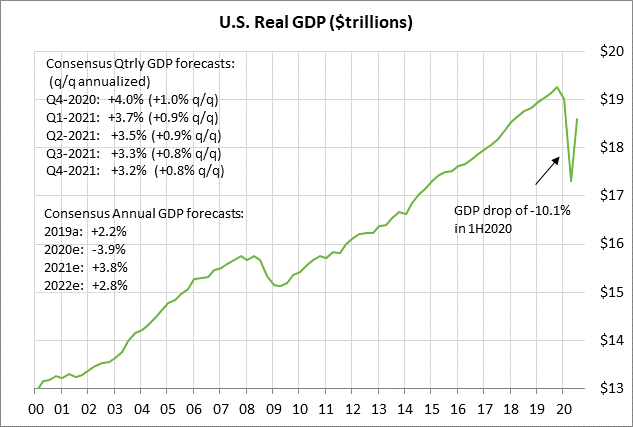
U.S. GDP rebounded higher by +7.4% q/q in Q3, but that wasn’t enough to overcome the -10.1% plunge seen in the first half of 2020. GDP would have to rise by another +3.6% to match the record GDP level of $19.254 trillion seen in Q4-2019.
However, GDP is not likely to reach that pre-pandemic high until Q3 or Q4 of next year. The consensus is for GDP reports of only +1.0% q/q (+4.0% q/q annualized) in Q4 and about +0.8% q/q (+3.2% q/q annualized) in every quarter in 2021. Moreover, GDP estimates will be trimmed in the coming weeks due to the worsening pandemic, which is forcing tighter restrictions across the country that will hurt economic growth.
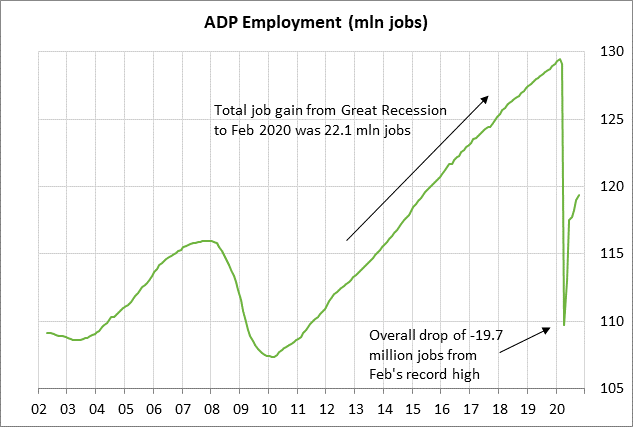
Nov U.S. ADP report expected to show a continued recovery in U.S. labor market — The consensus is for today’s Nov ADP employment report to show an increase of +430,000, which would show a stronger labor market than October’s rise of +365,000. ADP jobs have so far recovered only 49% of the plunge seen earlier this year in March-April. ADP jobs have risen by +9.641 million jobs from April’s pandemic low, but would have to rise by another +10.070 million to match February’s pre-pandemic record high.
The markets are looking ahead to Friday’s Nov unemployment report, which is expected to show a +486,000 rise in payrolls, fading a bit from October’s increase of +638,000. Payroll jobs have so far recovered only 54% of the plunge seen earlier this year in March-April. Payroll jobs have risen by +12.070 million jobs from April’s pandemic low, but would have to rise by another +10.090 million to match February’s pre-pandemic record high.
The consensus is for Friday’s Nov unemployment rate to fall by -0.1 point to 6.8%, adding to October’s sharp -1.0 point drop to 6.9% from November’s 7.9%. The unemployment rate has fallen by more than half to 6.9% from the record high of 14.7% seen in April, but is still nearly double the post-pandemic record low of 3.5%.