- Texas energy system starts to recover
- U.S. pandemic statistics continue to improve
- U.S. existing home sales expected to fade a bit
Texas energy system starts to recover — The Texas energy system is starting to recover as the weather improves. The forecast for Midland, Texas, which is in the heart of the Permian shale basin, is for today’s high to be 46 degrees Fahrenheit, improving to 55 degrees by Sunday, and to 65-70 degrees by next Tues-Wed. That would be a dramatic improvement from the 30-year low of -2 degrees Fahrenheit that Midland saw on Monday.
The warmer weather will allow power plants of all types to thaw out and begin generating electricity again. Indeed, power outages were less severe on Thursday. There are hopes that power can be fully restored by this weekend.
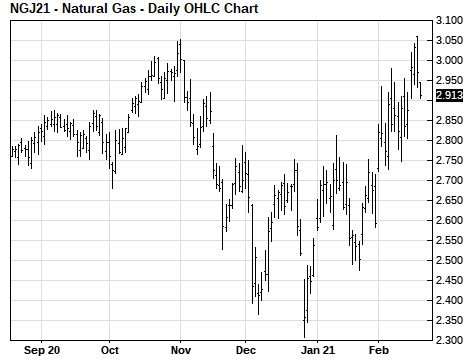
Meanwhile, petroleum and natural gas prices on Thursday started falling back after the upward spikes seen earlier in the week. March nat-gas prices on Thursday fell by -4.26% on the forecasts for warmer weather in the South, which should reduce nat-gas heating demand and allow supply to come back online. March nat-gas prices earlier this week rallied by +7.48% on Tuesday and +2.88% on Wednesday.
Meanwhile, March WTI crude oil prices on Thursday fell by -1.01%, giving back part of the rallies of +0.98% on Tuesday and +1.82% on Wednesday. Crude oil prices rallied on this week’s 40% plunge in U.S. oil production, but are now weakening due to the resumption of some of that production and due to weak crude oil demand from closed refineries.
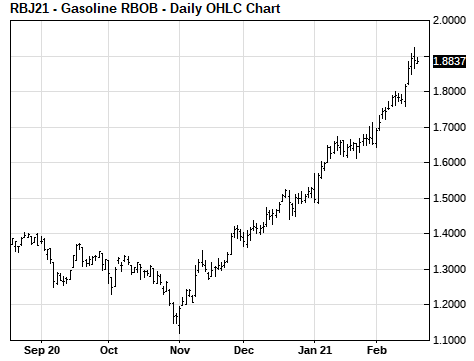
March RBOB gasoline prices on Thursday fell by -0.89%, giving back part of the rallies of +4.75% on Tuesday and +2.12% on Wednesday. Gasoline prices have rallied sharply on supply disruptions as many Texas refineries were knocked offline by the cold weather that froze facilities and caused electricity blackouts.
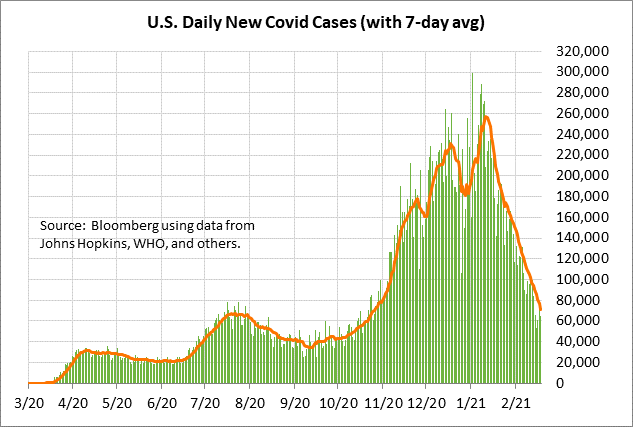
U.S. pandemic statistics continue to improve — The number of new U.S. Covid infections continues the free-fall that started in mid-January. The 7-day average of new U.S. Covid infections fell to a new 4-month low of 71,338 on Thursday, which is down by -72% from the peak of 256,820 seen on January 11.
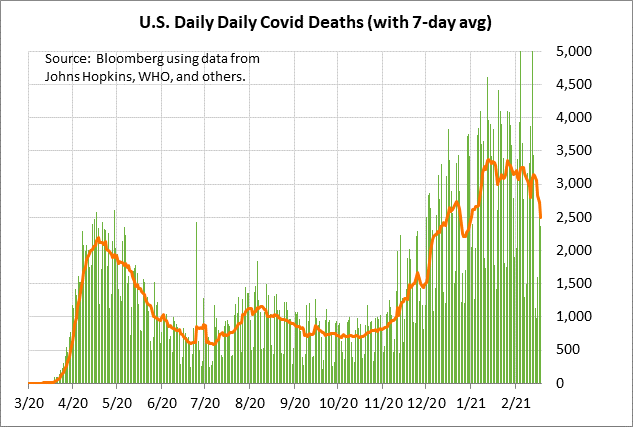
The 7-day average of U.S. Covid-related deaths fell to a 6-week low of 2,503 on Thursday, which is down by -26% from the record high of 3,366 seen on January 13. The Covid death rate remains high but should start dropping more quickly as it catches up with the lower initial infection rates.
The level of new U.S. Covid infections has dropped sharply in the past four weeks due to (1) the end of the Nov-Dec holiday spike, (2) the continued focus on social-distancing, wearing masks, and restrictions on public gatherings, (3) a likely seasonal improvement as respiratory infections in general start falling at this time of year, and (4) the increased immunity in the U.S. population due to vaccinations and a recovery from a Covid infection.
At least 20% of the U.S. population now has acquired some degree of immunity to Covid. There have been 59.1 million vaccination doses given in the U.S., accounting for 17.8 doses per 100 people, according to Bloomberg’s vaccine tracker. Meanwhile, 27.4 million Americans (8% of the U.S. population) have been infected with Covid and recovered, meaning they have some level of immunity.
While there is overlap among those figures, the implication is that more than 20% of the U.S. population now has some level of immunity to the disease. There is a long way to go for herd immunity, but the current level of immunity is a good start and is slowing the spread of the disease.
Moreover, the U.S. is now vaccinating 1.6 million people per day, which accounts for 0.5% of the U.S. population. Also, more vaccination doses are on their way, and that should substantially boost the daily vaccination figures in the coming weeks.
The wildcard, of course, continues to be the Covid variants that have invaded the U.S. from the U.K., South Africa, and elsewhere. These variants are more transmissible and may be less inhibited by the current vaccines, particularly the South African variant.
The trick for public health officials is to get the vaccines out to the public faster than the new Covid variants take hold. The ultimate goal is to get to herd immunity, which would slow Covid to a trickle and allow normal life to largely resume.
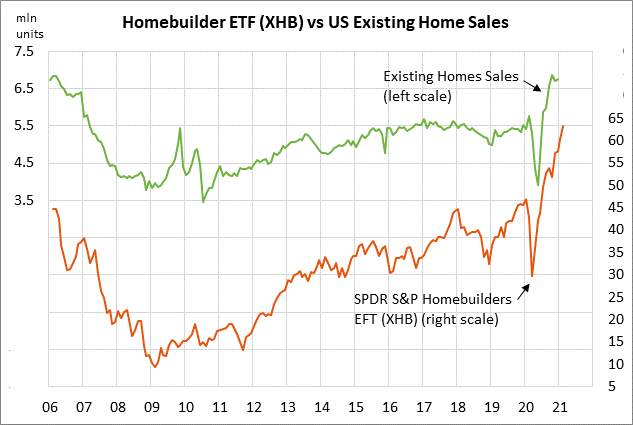
U.S. existing home sales expected to fade a bit — The consensus is for today’s Jan existing home sales report to show a decline of -2.4% to 6.60 million, more than reversing December’s small +0.7% increase to 6.76 million.
Existing home sales in December remained very strong at only -1.5% below November’s 15-year high of 6.86 million units. During the pandemic, U.S. home sales have soared because of people looking for larger homes to work from home or to home-school children, or to escape from urban areas.
However, home sales may start to fade as the pandemic starts to slow and people expect to get back to work and school. Also, home sales are likely to fade because there are so few homes available for sale. In December, the supply of homes on the market fell to a record low of 1.8 months.