- Tonight’s Trump-Biden presidential debate has the potential for some poll-shifting developments
- Pelosi unveils new $2.2 stimulus bill as the basis for negotiations
- Brexit negotiations reach crunch time
- Home prices expected to edge higher
Tonight’s Trump-Biden presidential debate has the potential for some poll-shifting developments — The first of the three Trump-Biden debates will be held tonight from 9:00-10:30 ET at Case Western Reserve University and the Cleveland Clinic, in Cleveland. The debate will be moderated by Fox News anchor Chris Wallace.
The topics for the debate have already been determined. The debate will spend about 15 minutes on each of the following six segments: Trump’s and Biden’s records, the Supreme Court, Covid-19, the economy, race and violence in U.S. cities, and the integrity of the election.
The only vice-presidential debate will be held next Wednesday (Oct 7). The second and third Trump-Biden debates will be held on Oct 15 and Oct 22. There are now only 35 days left until the November 3 election.
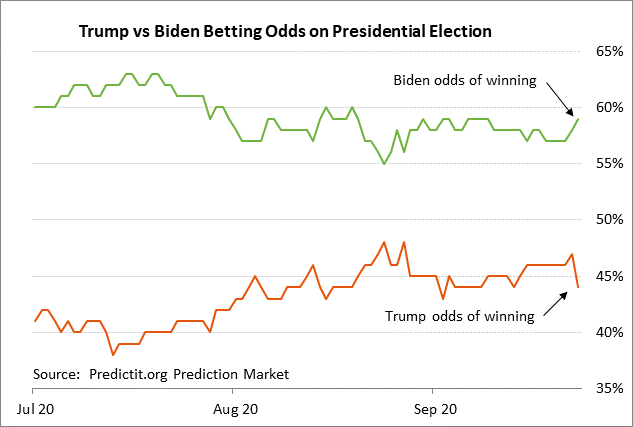
The markets will be carefully watching to see if tonight’s debate causes any shift in the polls. A recent WSJ/NBC poll found that 70% of Americans say the debates won’t matter to them, but there is always room for surprises.
The betting odds on Monday took a small turn against President Trump by a margin of four points, presumably because of Sunday’s NYT report on Mr. Trump’s tax returns. The betting odds late Monday were at 59% for a Biden win (up by 2 points from Saturday’s 57%) versus 44% for a Trump win (down by 2 points from Saturday’s 46%).
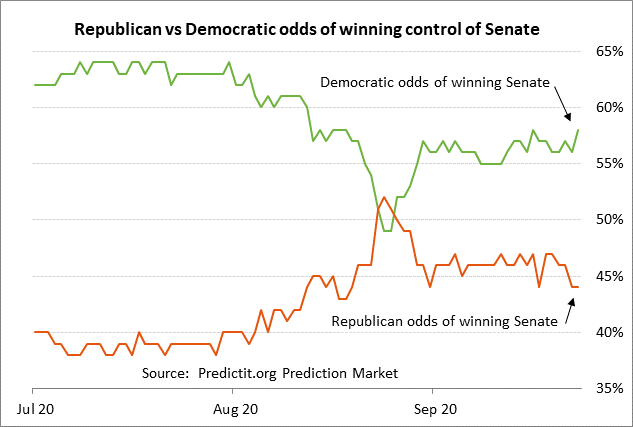
The betting odds for control of the Senate are at 58% for the Democrats and 44% for the Republicans. The betting odds for control of the House are at 84% for the Democrats and 18% for the Republicans.
Pelosi unveils new $2.2 stimulus bill as the basis for negotiations — House Speaker Pelosi yesterday generated some market optimism by saying that she thinks Democrats and Republicans can find “common ground” on a Covid relief package and is “hopeful” that a bipartisan stimulus deal can be reached. However, she didn’t suggest that there had been any movement in negotiations and she said that Republicans will have to “come back with much more money to get the job done.” Speaker Pelosi and Treasury Secretary Mnuchin have reportedly had three phone calls since last Friday.
In a sign of some slight progress, the House Monday evening released a proposed $2.2 trillion pandemic stimulus bill, which was down from last week’s level of $2.4 trillion although in line with Ms. Pelosi’s repeated demand in recent weeks for $2.2 trillion. According to The Hill, the bill contains $436 billion in emergency aid for state and local governments; an additional $1,200 stimulus check for most Americans; the restoration of the $600 per week unemployment bonus through January; $75 billion for pandemic testing, tracing and other health-care efforts; billions for housing assistance; funding to support the Census, Post Office, and elections; and aid for airlines and small businesses.
Ms. Pelosi told her caucus Monday evening that the bill will provide the basis for negotiations with Republicans. However, if the negotiations are not successful, then the House will likely vote on the bill before recessing this Friday.
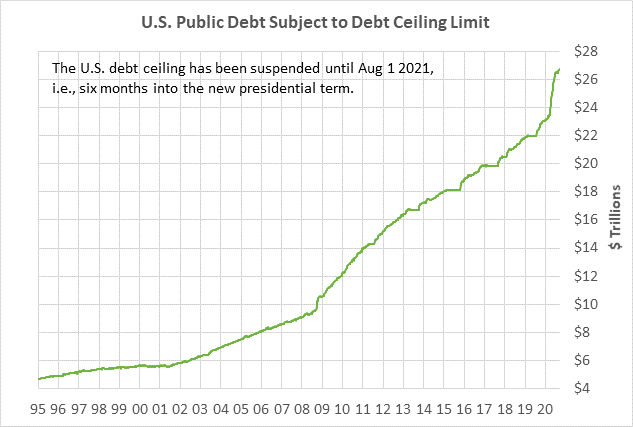
The failure of Congress thus far to pass a new stimulus bill is causing worries that the economic recovery will begin to stall in Q4. The lack of new government stimulus action prompted JPMorgan Chase last Friday to cut its U.S. Q4 GDP estimate to only +2.5% (q/q annualized) from +3.5%, and Goldman Sachs last Thursday to cut its U.S. Q4 GDP estimate to +3.0% (q/q annualized) from +6.0%.
Brexit negotiations reach crunch time — The last formal round of Brexit negotiations begins today. The goal is to have the main contours of a deal by Friday, allowing the two sides to go into the so-called Brussels “tunnel” for two weeks of intensive and secret negotiations to produce a final deal in time for the Oct 15-16 EU Summit. The EU needs a deal to be concluded by Oct 15-16 so that EU leaders can sign off the deal and give national legislatures time to ratify the deal before Dec 31 when the Brexit transition period expires. Prime Minister Johnson has said that the Oct 15-16 Summit is also his deadline for a deal.
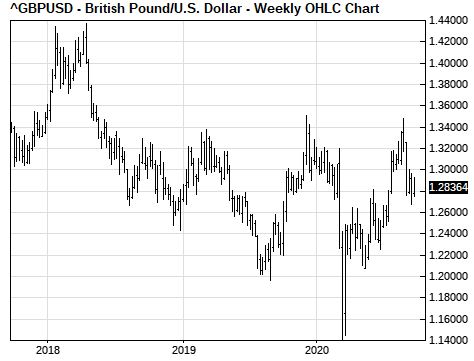
The two sides continue to posture and play hardball, but the time has arrived for the two sides to either reach a deal or for the UK to crash out of the EU single market on January 1. The market consensus seems to be that a deal will be made, although at the last possible moment. The key issues include state aid, fisheries, and deal enforcement. The EU also wants Prime Minister Johnson to withdraw his Internal Market Bill that breaks international law and would effectively set a hard border on the Ireland/Northern Ireland border.
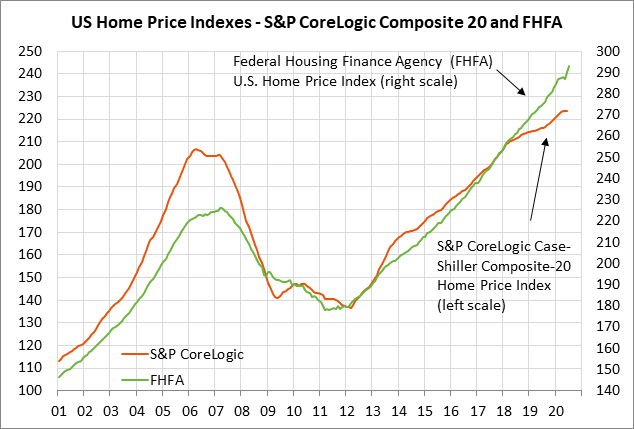
Home prices expected to edge higher — Today’s July S&P CoreLogic composite-20 home price index is expected to show an increase of +0.1% m/m and +3.6% y/y following June’s report of unchanged m/m and +3.5% y/y. The FHFA has already reported that its U.S. home price index in July rose sharply by +1.0% m/m, adding to June’s +1.0% increase. Home prices are seeing an upward squeeze due to strong demand and tight supply.
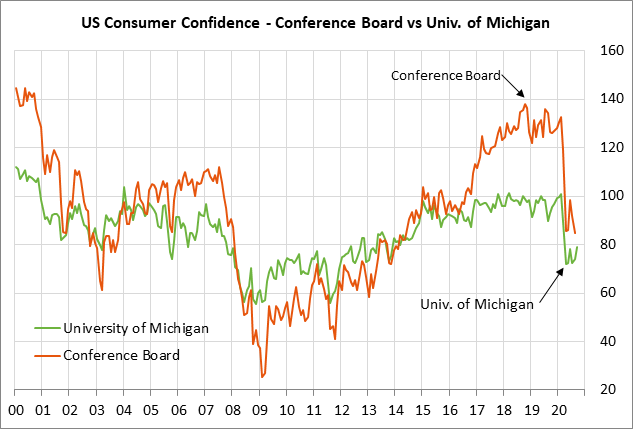
Sep U.S. consumer confidence expected to rebound a little higher from 6-year low — The consensus is for today’s Sep Conference Board U.S. consumer confidence index to show an increase of +5.2 to 90.0, recovering most of August’s -6.9 point decline to a new 6-year low of 84.8. U.S. consumer confidence remains in poor shape due to the continued high level of unemployment, doubts about the durability of the economic recovery, the lack of any new government stimulus, and political uncertainty about the outcome of the Nov 3 election.