






The USDA’s February WASDE report could make for interesting reading as it will be their first update since the official signing of the Phase One trade deal with China. However, with very little concrete developments since the signing, USDA may choose to take a wait-and-see attitude towards demand revisions at this time.
Wire services had not yet posted average trade estimates for next Tuesday’s reports as of this writing. Accordingly, we will provide a summary of them on Market Insights as soon as possible.
NOTE: There are tons of questions/uncertainties as to how USDA may handle demand estimates in the U.S. balance sheets in the monthly WASDE reports moving forward. They have been rather tight-lipped on the situation so far with most comments reflecting back on their stance throughout the trade war that their estimates always are made under the “policy in place†standards at the time of the report. What that means now that the Phase One trade deal has been signed, even though very little new business and/or signs of any pending new business to come have been seen remains uncertain. A recent newswire article cited a USDA official stating, the agency’s global crop supply and demand report will “factor in all provisions of the China deal that are publicly available.†Analysts will consider China’s demand, in light of the trade deal, to develop estimates for individual commodities. USDA is planning to issue a white paper explaining their approach soon, “hopefully before the next WASDE.†As of this writing, no further information directly from the USDA has been made available. The “publicly available†information from the trade deal announcement is limited to the value “pledges†for total ag product imports in 2020 being $12.5 billion above the total value of imports in 2017, which was about $20 billion, so 2020 ag product imports would around $32.5 billion and rising to around $40 billion in 2021. Specific quantity/value pledges by commodity are not part of the publicly available information in the trade deal. Moreover, President Trump’s chief economic advisor Larry Kudlow said in an interview on Tuesday that “the export boom from that trade deal will take longer because of the Chinese virus,†adding further difficulty for the USDA in how or whether to address export ideas in this month’s update. Personally, with very little new in terms of concrete developments and/or sales being made, we don’t see USDA having any hard data in order to make sweeping changes to U.S. ag export ideas at this time. USDA has a strong history of wanting/needing to see actual data to make demand-related revisions in the WASDE report, which we simply do not see at this time. Accordingly, we are heading into this month’s report of the opinion a traditional approach will be taken by USDA regarding export estimates based on known/reported sales and shipment data as they currently stand.
Corn
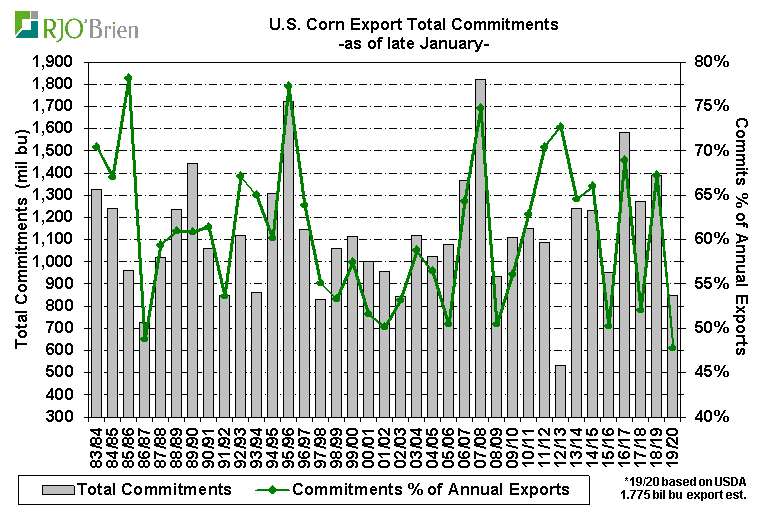
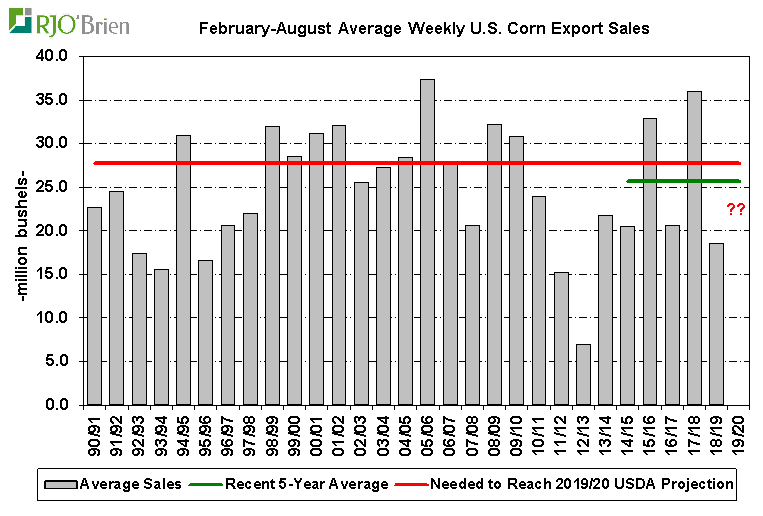
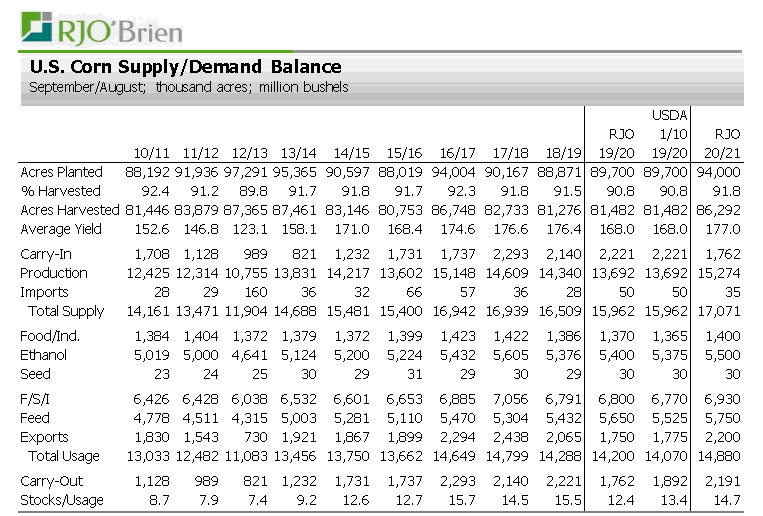
With supply-side revisions to the U.S. balance sheets all but complete following the USDA’s January 10 Annual Crop Production report, the focus now shifts entirely to the demand side of the equation. For the most part, taking a pure “as it looks today†approach, one can argue for little change being made to the U.S. corn balance sheet at this time. Export business has improved of late with U.S. supplies becoming competitive against South American origin as the Brazilian export program seasonally winds down. Over the last three weeks, U.S. corn Export Sales averaged nearly 40 million bushels/week, well above roughly 26 million/week average throughout the September-December period and above the roughly 28 million bushels/week average we estimate is “needed†in order for the USDA’s 1.775 billion bushel export projection to be met. While total commitments of 848 million bushels remain a massive 39% below last year at this time, the recent improvement in the export dynamic should be enough, in our opinion, to prompt USDA to leave their export estimate unchanged for the time being. Certainly there are prospects for at least some modest corn exports to China to eventually occur, but there have been no signs of that whatsoever yet and with China’s hands full dealing with the coronavirus situation, we feel it is unwarranted/unjustified for USDA to make any assumptions in that regard just yet.
While current sales on the books are the lowest in seven years for late January and reflect just 48% of the USDA’s export projection, which would be the lowest on record and clearly calls their annual estimate into question, accordingly, the similarities of the current situation to 2017/18 and 2015/19 cannot be ignored. Both of those years featured historically strong Brazilian corn export programs from August through January, which very abruptly and significantly slowed from February forward as appears to be occurring this year, as well. As seen in the following chart, the U.S. sales programs during Feb-Aug in both years were quite strong, providing optimism for a much-improved situation this year moving forward, as well. The current 28 million bushel/week average “needed†sales pace is well below the 36 million/week and 32.9 million/week average sales paces in those two years during Feb-Aug, further supporting prospects the USDA’s export projection can still be reached even with the very poor start to the year. For now, we simply don’t feel USDA has the statistical justification to raise exports based on optimism of eventual sales to China being made, while the improved competitiveness of U.S. corn of late should be enough to hold the line for the time being.
Shifting to the ethanol situation, in similar fashion to exports, after a very poor start to the marketing year in which weekly ethanol production ran 3.6% below last year’s pace throughout the Sept-Nov period, fortunes changed in early December with production averaging 3.4% above year ago levels over the last eight weeks. However, unlike exports in which the overall situation remains encouraging, ethanol margins have again come under pressure slowing production rates in recent weeks and likely leaving USDA on the sidelines this month regarding their 5.375 billion bushel annual corn for ethanol usage estimate. In the following chart, we outline various “needed†ethanol production rates relative to last year under different annual corn for ethanol usage assumptions. Based on year-to-date corn for ethanol usage, we estimate ethanol production will need to run roughly 0.5-1.0% above year ago levels, on average, through the end of August in order to reach the USDA’s 5.375 billion bushel target. We feel this is currently an appropriate reflection in consideration of the pullback in margins, when also kept in context of last year’s rather weak production rates over the upcoming 8-10 week comparison period. In order for 2019/20 corn for ethanol demand to prove 50 million bushels above the USDA’s current estimate, ethanol production would likely need to run roughly 2.1% above year ago levels on average through August, while 50 million bushels in lower corn usage would result if ethanol production slips to around 1.0% below year ago levels from this point forward. The latest week’s year-over-year production gain surged to a near 5-year high amid a rebound in production in combination with a sharp decline in production the same week last year, but is definitely viewed as a near-term aberration. We’re currently estimating 2019/20 corn for ethanol usage at 5.400 billion bushels.
Our main difference with the USDA’s 2019/20 U.S. corn balance sheet is on feed/residual usage, but they are rather unlikely to make a revision this month just having done so in the January report. USDA typically does not make changes to feed/residual usage again until after the end of March Grain Stocks report, so our higher feed/residual usage and lower ending stocks ideas are very unlikely to be reflected at this time. Implied quarterly feed usage has again found increased variability/statistical questioning, but with 1st quarter (Sept-Nov) feed/residual usage being implied at 2.640 billion bushels, up nearly 20% from last year, the USDA’s 5.525 billion bushel annual estimate reflected expected 2nd-4th quarter total feed/residual usage of just 2.885 billion bushels which would be down more than 10% from last year’s 3.224 billion. While there may be some statistical adjustment to 1st quarter usage when the March Grain Stocks report is released, it is unlikely to be of a magnitude implied by the USDA’s annual estimate at this time. Animal numbers have been and continue to run above year ago levels overall supporting continued solid feed usage ideas moving forward. We’re estimating 2019/20 U.S. corn feed/residual usage at 5.650 billion bushels, 125 million above the USDA and would put 2nd-4th quarter combined usage at 3.010 billion bushels. Again, though, we do not expect USDA to reflect this type of an adjustment this month.
Based on our higher feed/residual usage ideas, we’re estimating 2019/20 U.S. corn ending stocks at 1.762 billion bushels vs USDA last at 1.892 billion. However, we would not be surprised, whatsoever, if the USDA’s ending stocks estimate is little-changed this month. The USDA’s annual Ag Outlook Forum is just around on the corner February 20-21, which will provide the USDA’s first semi-official view of their 2020/21 outlook. Keep in mind in the USDA’s early 10-year baseline projections released in early November, USDA pegged next year’s U.S. corn ending stocks at 2.754 billion bushels vs old crop stocks at the time estimated at 1.929 billion.
Soybeans
With the brunt of the Phase One trade deal expected to fall on the shoulders of U.S. soybean exports, the uncertainty of how USDA will handle the entire situation is even greater. Unfortunately, as is the case with corn, there simply is no hard, concrete evidence/data since the January 15 signing to warrant materially revising the USDA’s export projection at this time. Additionally, it must be kept in mind the trade deal with China may end up being more of a switching around the flow/pattern of exports more than the actual creation of additional demand. Prospects for China restocking state reserves could be a temporary, one-time difference in that regard, but at the end of the day, global demand is global demand and while it continues to modestly rise overall, the significant issues going in China with African swine fever and coronavirus epidemic clearly call big picture demand ideas into question. Needless to say, there are no easy answers here with the trade deal, but we are hard-pressed to see USDA making large-scale increases in their U.S. soybean export projection given what is known, or more importantly what is not known, at this time.
As of January 9, prior to the January WASDE report, China had 11.4 MMT of U.S. soybeans officially on the books according to the Export Sales report. The latest Export Sales data, as of 11/23/20, reflects total commitments by China of 12.0 MMT, an increase of roughly 600k tonnes, but nearly 300k tonnes was the result of a change in reported destination from “unknown†to China and not new sales. Clearly since the trade deal signing, there has been very little new buying activity of U.S. soybeans by China and with South American values well below those of the U.S. and their seasonal export window just opening, prospects for a material change in status of the U.S. soybean export program to China in the near term appear quite limited. A look at the soybean export line-up out of Brazil shows roughly 7 MMT slated for shipment in February, easily a new record for the month in surpassing last year’s 5.3 MMT, with around 110 soybean vessels on the docket for shipment to China in the month alone. Hard to see how a notable increase in U.S. soybean exports works into that equation in the near term…
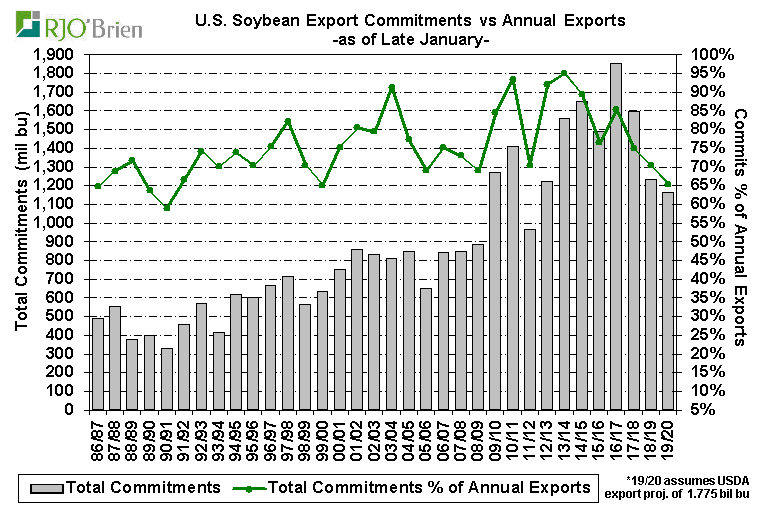
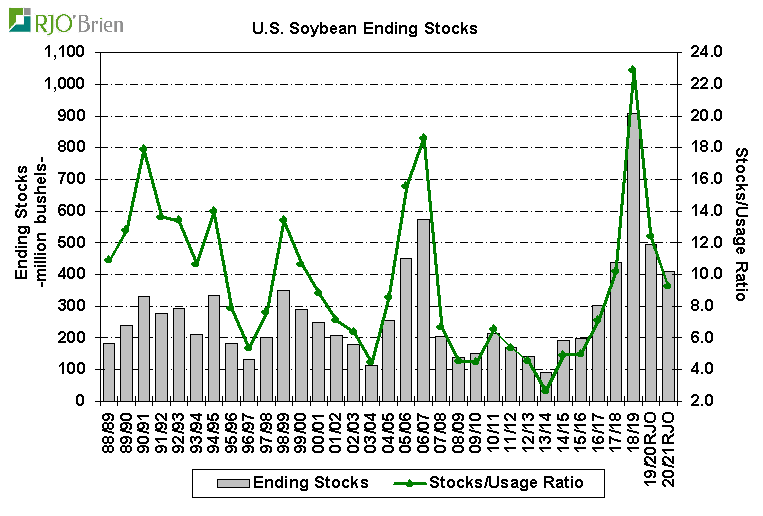
Everything about the snapshot look at the U.S. soybean export program as it stands today would appear to imply the USDA’s 1.775 billion bushel export projection is too high. However, with the backdrop of the signed Phase One trade deal and the massive ag product import values promised, it feels unfathomable to lower export ideas at this time regardless of the current export program status. Total export commitments of U.S. soybeans stand at 1.164 billion bushels, 5.6% below last year’s estimated 1.233 billion bushels at this time (direct comparison to year ago sales is not available due to the government shutdown so we’re estimating based on total sales during the shutdown period) and the lowest late January sales on the books in eight years. Moreover, sales on the books represent only 66% of the USDA’s annual export projection, while not a single year’s late January sales have represented less than 69% of eventual annual exports in the last 20 years. In other words, relative to expected annual exports, the current sales pace is the weakest since 1999/00. In any other case, we would expect USDA to lower their export projection this month, but we simply cannot go there with the numbers being thrown around as part of the trade deal.
If the USDA’s export projection is to be met, U.S. soybean sales during Feb-Aug will need to average roughly 20 million bushels/week, modestly above the previous two year’s 18.0 million and 18.1 million/week averages from this point forward and would be record high. Again, without the trade deal, we’d simply say no way, but we feel USDA will largely be forced to take a wait-and-see attitude with their export projection for this month’s update.
Soybean crush, overall, has run solidly through the first four months of the 2019/20 marketing year with Sept-Dec crush of 709 million bushels only marginally off from last year’s record 715 million, leaving Jan-Aug crush needing to total 1.396 billion bushels in order to reach the USDA’s current 2.105 billion bushel annual projection, 1.4% above last year’s 1.377 billion bushels during the same period. As seen below, though, last year’s crush rates in February, March, May and June were below record levels (May and June considerably so), which keeps the USDA’s annual target within reach comparatively speaking as long as crush margins/product demand remains strong. U.S. soybean product export demand has been impressive of late given the reduced Argentine crush activity amid the Vicentin debt restructuring forcing a considerable decline in soybean meal and oil production since mid-December. U.S. soybean crush margins remain stable and above year ago levels, as seen in the 2nd chart below, and just below 2018 prior to the considerable strength in margins over the coming months. For now, we see no reason to doubt the USDA’s 2019/20 crush estimate and look for no change in the February WASDE. We’re currently at 2.110 billion bushels, marginally above USDA.
With the U.S. export sales pace continuing to run below year ago levels and South American exports about to explode seasonally, despite the Phase One trade deal, we simply feel it is fundamentally unjustified to raise U.S. export projections at this time. If and when a true change in export demand is seen, this entire argument will obviously be re-examined but with South American values well below U.S. and the myriad issues in China right now, we’re holding tight for the time being. Accordingly, our 2019/20 U.S. soybean ending stocks estimate sits at 495 million bushels vs USDA last at 474 million. An expected significant rebound in soybean acreage next year should allow for a large-scale increase in U.S. exports while still maintaining a comfortable stocks levels. At this time, it is simply impossible to accurately assess 2020/21 export prospects. However, with a 10 million acre rebound in planted area to 86.0 million, after last year’s 13.0 million acre loss, and a return to average yields, U.S. soybean exports next year could conceivably surge to 2.150 billion bushels – up 400 million from this year and just short of all-time record exports of 2.166 billion in 2016/17 – and still see ending stocks around 400 million bushels.
Wheat
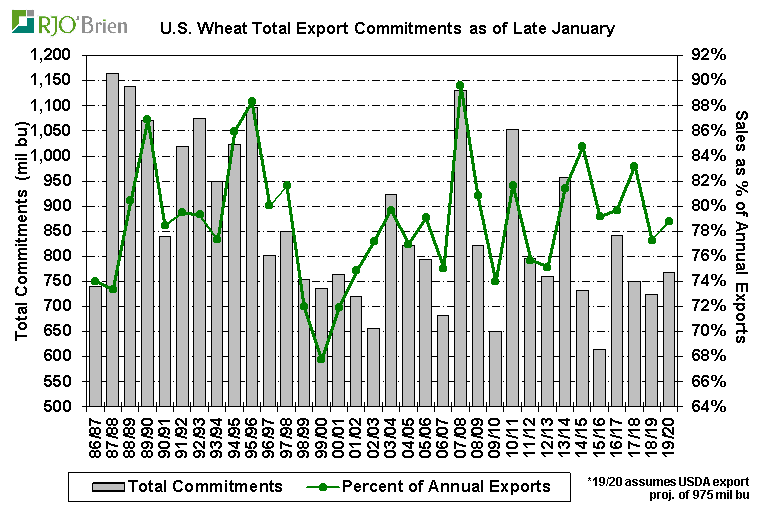
While not anything to consider historically strong/impressive, recent export sales activity for U.S. wheat has been quite respectable. Over the last seven weeks, export sales have averaged 20.8 million bushels/week, considerably above the roughly 10.3 million/week average currently needed in order to reach the USDA’s 975 million bushel export projection and the highest for the specific period in nine years. Over the last five years, wheat export sales during the same 7-week period averaged just 14.0 million bushels/week. Moreover, total commitments of 769 million bushels are currently up roughly 6% from last year, slightly ahead of the USDA’s annual export projection reflecting an expected 4.2% increase in exports, and are the highest in three years and the 2nd highest of the last six years for late January. Current sales on the books represent 79% of the USDA’s export projection, a bit above last year’s 77% late January sales-to-final exports relationship and right in line with the 10-year average of 79% indicating no issues with the overall sales pace relative to estimated annual export in historical terms. Nothing spectacular, but certainly respectable and supportive of the USDA’s current export projection. If anything, we feel USDA may bump their U.S. wheat export projection a bit higher this month as we’re at 1.000 billion bushels, 25 million above USDA.
We feel the USDA’s 2019/20 feed/residual usage estimate of 150 million bushels is respectable as it would require a 2nd half (Dec-May) residual of -52 million bushels, right within the range of the last five years’ -25 to -75 million. 2019/20 total 1st half feed/residual usage of 202 million bushels compares to the 110 to 236 million bushels over the last five years, but we would note 2016/17, which saw the largest 1st half feed/residual of 236 million bushels of the last five years also saw the largest 2nd half negative residual of -75 million bushels for the period, as well. We’re leaning slightly lower than USDA because of this, but is largely an immaterial difference in the big picture as we pencil 2019/20 annual reed/residual usage at 140 million bushels.
Overall, our 2019/20 U.S. wheat balance sheet ideas are in line with USDA as our slight differences in exports and feed/residual usage largely offset for our ending stocks estimate of 960 million bushels vs USDA last at 965 million. The U.S. wheat fundamental picture continues to improve from the overly burdensome situation several years ago with ending stocks a 29-year high near 1.2 billion bushels in 2016/17. We see this pattern continuing into 2020/21, as well, as the lack of an increase in overall area, combined with a likely pullback in yields from last year’s historically high levels prompt an expected decline in U.S. wheat supplies and ending stocks, accordingly. While still not necessarily considered an outright bullish view, amid a likely difficult export environment once again, we do see prospects for U.S. wheat ending stocks to drop below 900 million bushels for the first time since 2014/15. It must be kept in mind that lower supplies are only relatively more valuable in the context of demand for those supplies. Without demand, reduced supplies may not be directly indicative or higher prices/values. We would argue the potential exists for longer-term positive price action in wheat, but is likely to be highly dependent on global demand developments in 2020/21, which at this time remain rather uncertain.
PRIVACY POLICYDISCLAIMERCOPYRIGHTABOUTRJO NEWSCONTACT US